Question: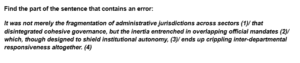
Options:
- (1)
- (2)
- (3)
- (4)
Correct answer : d)
Explanation :
Error is related to / concept
Tense consistency in complex sentences
What is wrong
The clause “ends up crippling inter-departmental responsiveness” is in the present tense, whereas the rest of the sentence is clearly written in a past-time context:
was not
disintegrated
entrenched
Because the sentence is anchored in the past, the final clause should also maintain past-tense consistency.
Grammatical Concept
In formal English, when the main clause is narrated in the past and there is no shift in time intended, the subordinate clause should generally follow the same tense framework.
Correct Form
Incorrect:
…which, though designed to shield institutional autonomy, ends up crippling inter-departmental responsiveness altogether.
Correct:
…which, though designed to shield institutional autonomy, ended up crippling inter-departmental responsiveness altogether.
The sentence discusses a historical situation and uses past-tense verbs throughout. The phrase “ends up crippling” suddenly shifts to the present tense, creating a tense inconsistency. Replacing it with “ended up crippling” preserves grammatical agreement and maintains a consistent narrative timeline.
Hence, part (4) contains the error and is the correct answer.