Question:
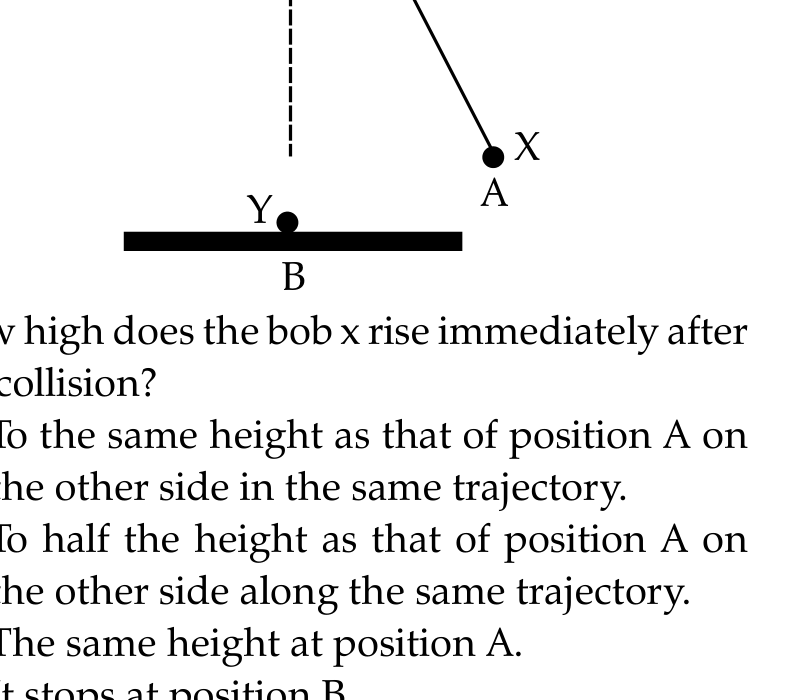
A metallic bob X of mass m is released from
position A. It collides elastically with another
identical bob Y placed at rest at position B on
a horizontal frictionless table. The angle AOB
is 30°.
How high does the bob x rise immediately after
the collision?
A metallic bob X of mass m is released from
position A. It collides elastically with another
identical bob Y placed at rest at position B on
a horizontal frictionless table. The angle AOB
is 30°.
How high does the bob x rise immediately after
the collision?
Options:
- To the same height as that of position A on
the other side in the same trajectory. - To half the height as that of position A on
the other side along the same trajectory. - The same height at position A.
- It stops at position B.
- To the same height as that of position A on
the other side in the same trajectory. - To half the height as that of position A on
the other side along the same trajectory. - The same height at position A.
- It stops at position B.
Correct Answer: D) It stops at position B.
Explanation:
In an elastic collision of identical masses, velocities are interchanged. Bob X transfers all its velocity to Y and comes to rest.
In an elastic collision of identical masses, velocities are interchanged. Bob X transfers all its velocity to Y and comes to rest.